




Deshoring Manifesto
Radically improving the economics of SAP consulting using Agentic AI
A proposed movement to accelerate the move to S/4HANA in order to modernize the tech stacks of some of the world's largest organizations in pursuit of competitive advantage and economic stability.
Stuart Browne
Founder and CEO
Stuart has worked in the SAP industry since 1997 for consultancies and service providers before founding Resulting in 2004. He is a thought leader on the shift to S/4HANA and delivering value with SAP.
The Big SAP Challenge
The SAP industry is at an inflection point unlike any in its thirty-year history.
Two-thirds of the 35,000 SAP customers who must migrate to S/4HANA haven't started yet – largely due to the lack of a compelling business case.
In a rapidly evolving new and uncertain economy, the single biggest commercial lever for most SAP customers* lies in how they deploy AI over their ERP data to gain competitive advantage. Ironically, in order to capitalize on AI within SAP, customers are advised to move to the latest version of S/4HANA on RISE – which is precisely what they’re currently struggling with ahead of the 2030 end of life ECC deadline. The time to exploit AI is now - ;yet the time it will take to get there will be too late for many enterprises. This is a potential meteor and dinosaur moment for some of the world's biggest companies.
*9/10 of the world’s biggest companies run SAP
The SAP workforce is aging and retiring, with no adequate pipeline of skilled replenishment. Offshore cost arbitrage has declined from 5:1 in 2006 to approximately 2:1 in 2025 - eliminating the primary economic rationale for a model that was already underperforming. Systems integrators command premium rates in a supply-constrained market, and their incentive structures don't always align with your success.
SAP's clean core strategy demands entirely new skills: understanding, documenting, and refactoring decades of custom code into cloud-ready development languages. And SAP as a product is accelerating in complexity faster than any individual consultant can keep pace with – composable ERP, APIs and event-based integration, cloud add-ons, new licensing models, hosting models, security models and decentralized information models to underpin AI.
Before these challenges emerged, SAP projects were already challenged – with success rates ranging from a coin-toss 50% of delivering business objectives to near-certain estimates that 70% of SAP projects will run over budget and schedule. These latest technological developments will only amplify these success odds at a time when organizations really need economic certainty.
The SAP industry is severely challenged - a new way of delivering SAP projects (cheaper, faster and better) is needed now more than ever.
What Is Deshoring?
Offshoring in the SAP industry emerged in the early 2000s.
Before Offshore, there was no Onshore.
But there was traditional SI consultancy which had followed a high-cost time and materials commercial model. Offshoring changed the economics of SAP delivery by moving high-cost skills to low-cost geographies to achieve a labor arbitrage. But expensive onshore delivery models continued to exist to counterbalance the challenges of fully remote, cross-cultural SAP delivery models.
Deshoring is not offshore or onshore.
It's not a geographic strategy.
Deshoring is the deliberate replacement of costly consulting and systems integration services (whether onshore or offshore) with Agentic AI: intelligent, always-on, commercially independent AI agents that work directly for and with your team.
Whereas offshoring moved work to humans in lower-cost geographies, Deshoring removes the human bottleneck - replacing it with AI capability that is faster, broader in knowledge, free from commercial bias, and continuously improving.
Deshoring breaks the cycle of vendor dependency, empowering businesses to become more self-sufficient, enabling them to own their own technology transformation initiatives.
And, like the Agile movement, Deshoring alters the efficiency of work to remove cost and delay.
Faster. Cheaper. Better. Pick Three.
Since NASA coined this phrase in the 1990s, the technology industry has told you that you can only choose two outcomes. You can have quality or speed, speed or cost, cost or quality - but never all three. You've now been told this so often that we’ve stopped questioning it.
It's time to stop taking this paradigm for granted.
Time to challenge.
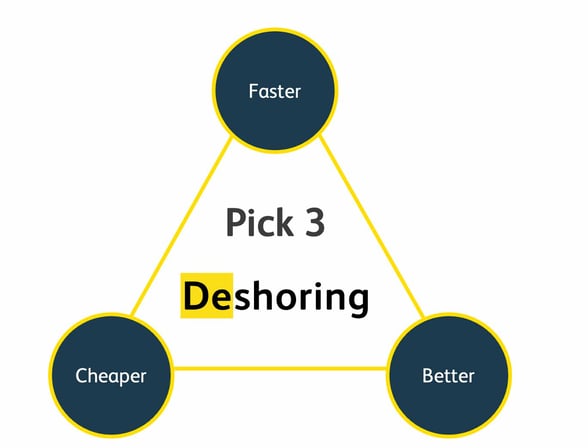
The “FCB” iron triangle is a constraint of the human delivery model. It exists because skilled humans are finite, expensive, and slow to mobilize. When you remove the constraint and replace the human bottleneck with Agentic AI the FCB triangle dissolves.
- Faster: AI agents operate quickly and continuously. No ramp-up time. No knowledge transfer delays. No resource availability gaps. Knowledge recall is instant. Rework through mistakes is all but eradicated. With Deshoring, delivery accelerates from day one.
- Cheaper: The elimination of systems integrator mark-ups, offshore management overhead, and human arbitrage costs reduces total spend on SAP programs significantly. Analysis of 180+ discrete SAP project tasks - spanning architecture, configuration, development, testing, and program management - demonstrates a cost-weighted reduction of 59% vs. traditional SI delivery models.
- Better: AI agents draw from an unparalleled breadth of SAP knowledge — not the narrow-band experience of a single consultant, but the full landscape of documented SAP capability. With Deshoring, solutions are no longer bounded by what one person has seen before.
59% is not a rounding error:
it’s a fundamental structural shift in economics.
A number like 59% demands scrutiny.
Here's how we arrived at it.
A team of highly experienced SAP architects and project managers established 186 discrete tasks that occur across typical SAP S/4HANA implementation projects - from initial landscape assessment and solution architecture through configuration, custom code migration, integration design, testing, cutover planning, and hypercare. For each task, they established a baseline: the typical effort, skill level, and cost under a traditional blended customer and SI delivery model, including offshore delivery
They then assessed each task against two variables:
- Effort reduction — how much faster does Agentic AI complete or support this task compared to a human consultant?
- De-skilling — where AI handles the analytical or generative heavy lifting, does the task now require a lower-cost human to review and approve, rather than a senior consultant to originate?
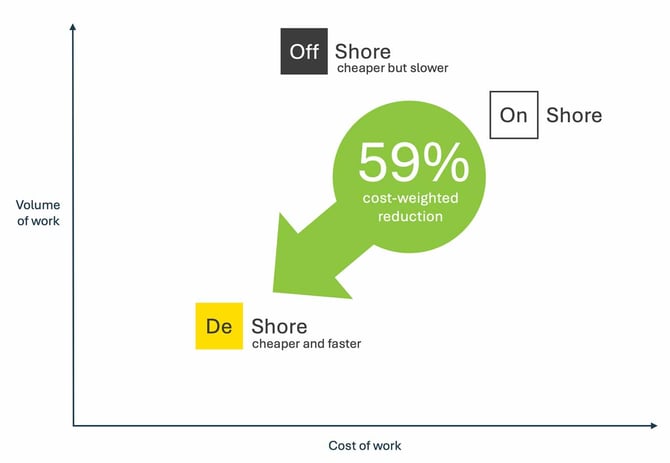
The blended cost-weighted reduction was estimated at a 59% potential saving across the 186 SAP project tasks. This potential is the Fold - the extent to which time and skills can be compressed vs. traditional SI delivery methods.
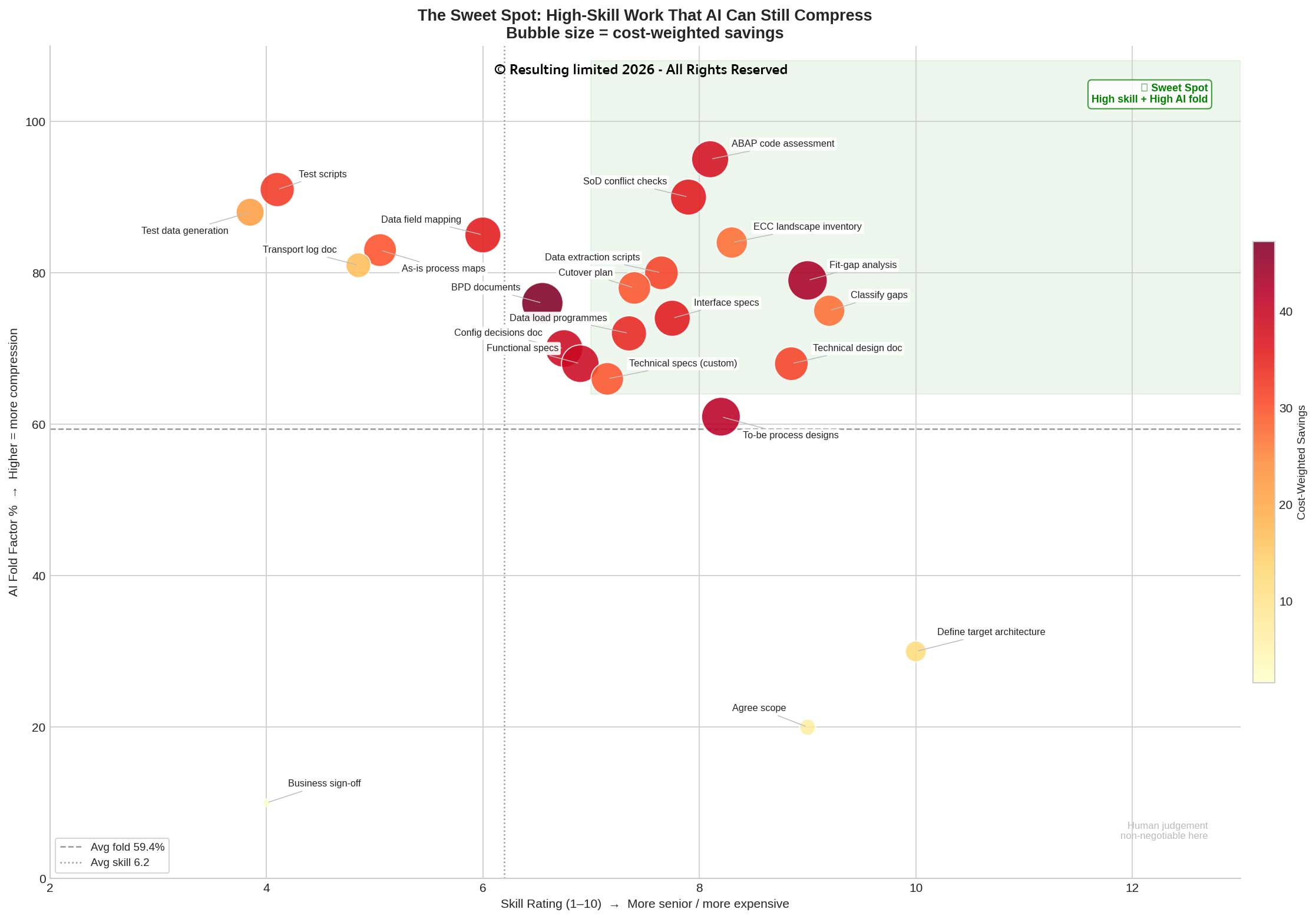
Deshoring Sweet Spot: High skilled work that Agentic AI can compress the most.
aka the Fold - the extent to which time and skills can be compressed vs. traditional methods.
Not every task reduces equally. Complex stakeholder alignment, organizational change management, and executive decision-making remain human-led. The savings are concentrated in the tasks where Agentic AI genuinely outperforms human delivery: documentation, configuration analysis, architecture options generation, test script creation, code analysis, and fit-gap analysis.
The 59% is a program-level average - your fold will depend on your landscape, your scope, and how you deploy AI capability within your team.
But the direction is unambiguous and the magnitude is significant.
6 Deshoring Principles
Deshoring is not a methodology. It's a movement built on a set of principles that apply wherever technology delivery relies on expensive human-mediated consulting models.
DESHORING PRINCIPLE 1
Customer Self-Sufficiency over
Vendor Dependency
You should be able to own your technology outcomes and set a realistic goal of building an internal team that is more capable, not more reliant.
Deshoring dismantles the dependency model that systems integrators and application management providers have built - and replaces it with empowered, self-sufficient capability, augmented by Agentic AI.
DESHORING PRINCIPLE 2
Breadth of Knowledge over
Narrow-Band Experience
When you invest in expensive packaged technology, you deserve solutions drawn from the broadest landscape of possibility - not from the limited vantage point of a single consultant or contractor's career.
A human consultant offers solutions based on what they've seen through their own experience in the past. An Agentic AI consultant offers solutions based on everything that's known.
DESHORING PRINCIPLE 3
Continuous Learning over
Static Capability
You should be able to unlock the value from every new (SAP) release, every industry development, from best practice ways of working and from modern technology evolutions. Otherwise, you run the risk of investing in modern technology and being hampered by decades-old experience.
Unlike a human consultant whose knowledge reflects their last engagement, Agentic AI evolves continuously. Consultants and contractors apply a “what worked last time” mindset and rarely invest time in updating knowledge and expertise.
DESHORING PRINCIPLE 4
Acceleration over
Time Lag
Transformation should be fast, but traditionally it isn’t. This is a consequence of outdated methods of solutioning, lack of alignment between experts and customers, lengthy iteration cycles to define, compare and approve solution options. Despite widespread adoption of agile in IT circles, it hasn’t moved the needle for SAP delivery.
Agentic AI can remove the bottlenecks that extend timelines and inflate cost by redressing the traditional knowledge status imbalance (via Principles 1-3) and accelerating through instant knowledge recall and rapid document production.
Speed is no longer a trade-off in the Deshoring model.
It's the new default.
DESHORING PRINCIPLE 5
Independence & Freedom From Bias over
Self-Serving Advice
You deserve advice that’s independent and free from bias. Systems integrators often recommend what serves their commercial model regardless of whether it is the best outcome for their customers.
Agentic AI has no billable hour incentive, no upsell motive, no preference for complexity over simplicity. Its objectives are more aligned with your desired outcomes.
DESHORING PRINCIPLE 6
Radical Cost Transparency over
Premium Opacity
The cost of technology advice should be transparent: explainable, justified, and fair.
Deshoring replaces opaque SI pricing with transparent, subscription-based AI capabilities - where every dollar spent is traceable to a specific outcome.
Deshoring shifts the long-established and accepted Time & Materials commercial model of consulting with reduced spend on tooling and tokens with clear ROI.
What does a Deshored Organization look like?
After Deshoring, your internal team looks different - and stronger.
You’ll have:
- A small, internal SAP capability that sets direction, governs outcomes, and manages the AI agents working alongside them.
- Dramatically reduced dependency on external SIs for day-to-day program delivery.
- A living, improving knowledge base - because your AI agents learn from every engagement, every configuration decision, every issue resolved.
- A broader church of knowledge of what’s possible with S/4HANA including the ability to automate fit-to-standard for decades of custom code.
- A cost structure that reflects actual value delivered, not consulting hours billed.
- The ability to respond to new SAP capability faster - without waiting for an SI to staff a team and get up to speed.
This transition takes time.
It will require investment in your internal team and in how you manage technology delivery.
But the direction is clear and the destination is worth the journey.
Join the Movement
Deshoring is not a product. It's a movement.
And movements need people willing to move first.
We're calling on SAP customers, technology leaders, and enterprise decision-makers to reject the status quo. Not out of frustration with their current vendors - but because a better model now exists, and the window to act is open.
You don't have to abandon everything that's working. You don't have to bet the program on an unproven technology. You start where the evidence is strongest, build confidence with results, and expand from there.
The technology exists. The opportunity is clear. The moment is now.
This manifesto was written by Stuart Browne, CEO of Resulting — an independent SAP consultancy committed to customer outcomes over consulting dependency.